


 Table of Contents
As organizations scale Agile beyond individual teams, a critical question emerges: how do you maintain alignment, speed, and business value at enterprise scale? What works for one Scrum team often breaks down when dozens—or hundreds—of teams are involved.
This is where Agile scaling frameworks come into play.
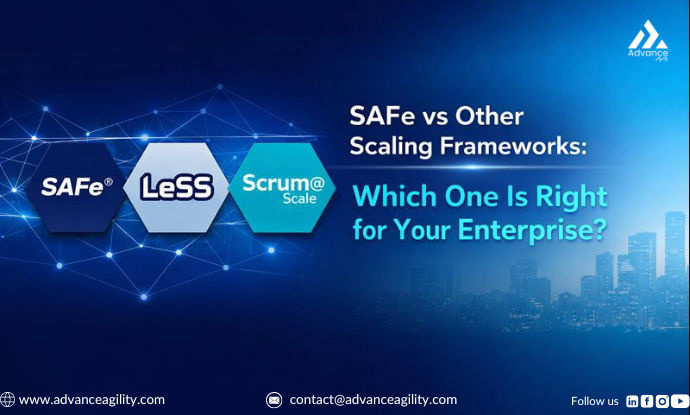
Among the most widely adopted frameworks are Scaled Agile Framework (SAFe®), Large-Scale Scrum (LeSS), and Scrum@Scale.
But which one is right for your enterprise?
In this blog, we compare SAFe with LeSS and Scrum@Scale to help you choose the framework that best fits your organization size, complexity, Agile maturity, and strategic goals—with practical guidance from real enterprise experience.
Why Agile Scaling Is Not One-Size-Fits-All
Agile scaling is not about adding layers of process. It’s about aligning strategy, leadership, teams, and execution across the organization.
Every enterprise differs in:
- Team size and geographical spread
- Regulatory and compliance requirements
- Leadership involvement and governance needs
- Existing Agile maturity
Choosing the wrong framework can slow delivery, create confusion, and reduce trust in Agile itself. Choosing the right one enables predictability, transparency, and sustainable agility.
Overview of the Leading Agile Scaling Frameworks
SAFe® (Scaled Agile Framework)
SAFe is the most widely adopted Agile scaling framework globally, designed specifically for large and complex enterprises.
Key characteristics:
- Structured guidance across Team, Program, Large Solution, and Portfolio levels
- Clearly defined roles such as Release Train Engineer (RTE), Product Management, and System Architect
- Built-in Lean Portfolio Management and strategy alignment
- Strong support for governance and compliance
SAFe is particularly effective for organizations transitioning from Waterfall or hybrid models to Agile at scale.
You can explore SAFe fundamentals and certification paths through Advance Agility’s SAFe® training programs.
LeSS (Large-Scale Scrum)
LeSS extends Scrum principles across multiple teams working on a single product.
Key characteristics:
- One Product Owner, one Product Backlog
- Minimal additional roles and ceremonies
- Strong emphasis on simplicity, transparency, and team autonomy
LeSS works best in organizations with high Agile maturity and a strong product mindset. It deliberately avoids management layers and formal governance structures.
Scrum@Scale
Scrum@Scale is a lightweight, modular framework designed to scale Scrum through collaboration networks rather than hierarchy.
Key characteristics:
- Two interconnected cycles: the Scrum Master cycle and Product Owner cycle
- Flexible and non-prescriptive implementation
- Focus on decentralized decision-making
Scrum@Scale suits organizations that already practice Scrum effectively and want to scale without heavy structural change.
SAFe vs LeSS vs Scrum@Scale: Key Comparisons
1. Organisational Size & Complexity
| Framework | Best Suited For |
| SAFe | Large enterprises (100+ teams), multiple value streams |
| LeSS | Small to mid-scale (2–8 teams), single product |
| Scrum@Scale | Mid-sized organizations scaling organically |
Insight:
If your enterprise operates across multiple products, vendors, or geographies, SAFe provides the most reliable structure for coordination and alignment.
2. Governance & Leadership Alignment
- SAFe explicitly integrates leadership, strategy, finance, and execution.
- LeSS intentionally minimises management involvement.
- Scrum@Scale supports leadership alignment but leaves structure emergent.
For organisations that require executive visibility, funding alignment, and decision clarity, SAFe offers a proven governance model without sacrificing agility.
3. Portfolio & Strategy Execution
This is one of SAFe’s strongest differentiators.
- SAFe includes Lean Portfolio Management, strategic themes, and value stream funding.
- LeSS focuses purely on product delivery and avoids portfolio concerns.
- Scrum@Scale leaves portfolio management largely to organisational design.
If your organization struggles to connect business strategy with delivery execution, SAFe provides an end-to-end solution.
4. Agile Maturity Requirements
| Framework | Required Agile Maturity |
| SAFe | Beginner to Intermediate |
| LeSS | High |
| Scrum@Scale | Intermediate to High |
LeSS and Scrum@Scale assume teams already have strong Agile discipline. SAFe, by contrast, supports organisations throughout their Agile transformation journey.
5. Industry & Compliance Considerations
Enterprises in banking, healthcare, telecom, and government often require:
- Risk management
- Architectural governance
- Audit readiness
SAFe addresses these needs with built-in practices, making it a preferred choice in regulated industries where lightweight frameworks may struggle.
Which Agile Scaling Framework Should You Choose?
Choose SAFe if:
- You are a large or complex enterprise
- You need strong portfolio visibility and governance
- You are transitioning from traditional delivery models
- Leadership wants alignment without losing agility
Choose LeSS if:
- You work on a single product
- Teams are highly mature in Scrum
- You value simplicity and minimal hierarchy
Choose Scrum@Scale if:
- Scrum is already deeply embedded
- You want a flexible, lightweight scaling approach
- You prefer emergent structures over prescriptive ones
How Advance Agility Helps You Scale Agile the Right Way
At Advance Agility, we don’t just deliver Agile training—we help organisations build scalable and sustainable Agile operating models aligned with real business outcomes.
We are a Scaled Agile Platinum Partner, the highest level of partnership awarded globally for SAFe® expertise and delivery excellence. This recognition reflects our proven capability in enabling enterprise-scale Agile transformations across industries.
Our consultants and trainers bring deep, hands-on experience in:
- Implementing SAFe® across complex, multi-team environments
- Enabling leadership, program, and portfolio agility
- Facilitating high-impact PI Planning and execution alignment
- Coaching organisations through real-world scaling challenges
Our services include:
- SAFe® certification training (SA, SSM, POPM, SPC)
- Enterprise Agile transformation consulting
- PI Planning simulation workshops
- Leadership and portfolio agility enablement
Explore our SAFe® training programs, PI Planning simulations, and enterprise Agile consulting services to start scaling Agile with confidence.
Final Thoughts
There is no universally “best” Agile scaling framework—only the right framework for your organizational context.
However, for enterprises seeking:
- Strategic alignment
- Predictable delivery at scale
- Governance without bureaucracy
SAFe consistently proves to be the most practical and enterprise-ready choice.
Ready to scale Agile with confidence?
Connect with Advance Agility today and design an Agile scaling strategy that actually works for your organization

view Count
2473