


 Table of Contents
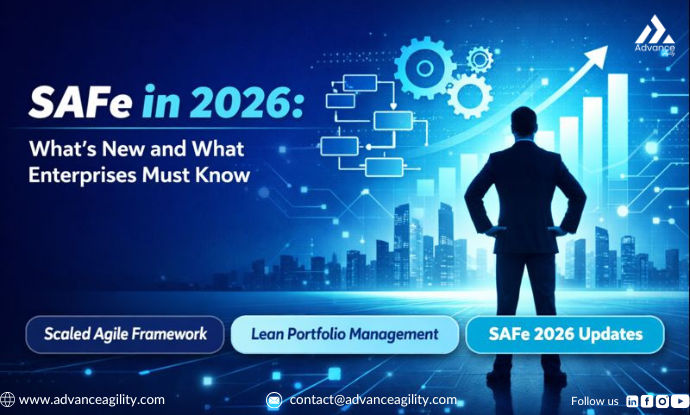
The Scaled Agile Framework (SAFe) continues to be the reference point for enterprises pursuing business agility. As organizations move through 2026, the practical focus has shifted from “adopt SAFe” to “operate SAFe for measurable business outcomes.” Below I summarise what’s new, why it matters, and concrete actions enterprises should take — written for SAFe professionals and optimized for discovery (SAFe 2026, Scaled Agile Framework, Lean Portfolio Management, SAFe updates).
The big picture: SAFe 6.x — refinement, not reinvention
SAFe’s recent updates (the 6.x line) refine the Big Picture and emphasize value flow, business agility, and modern enterprise challenges like distributed work and AI augmentation. These updates reorganize some terminology and add explicit guidance that helps link strategy to execution at scale.
Why it matters: enterprises now expect SAFe to help them measure and improve financial outcomes and time-to-market — not just team-level delivery metrics. The framework’s evolution reflects that demand.
Key themes in SAFe 2026 (what’s new)
- Clearer Value-Stream & Flow Focus — The Big Picture and guidance push organizations to model and optimize the flow of value across the enterprise (not just work in teams).
- Lean Portfolio Management (LPM) as the strategic linchpin — LPM remains central: aligning strategy, investment funding, and governance while using portfolio Kanban, lean budgets, and economic prioritization. Organizations are treating LPM as the bridge from C-suite strategy to Agile execution.
- Measurement of Business Outcomes & ROI — New SAFe resources and tools (2025–2026) explicitly support estimating and demonstrating ROI from transformations. Expect more guidance and artifacts for outcome-based metrics.
- AI & Modern Ways of Working — SAFe content and workshops now include AI-empowered assessments and practical advice for hybrid/remote teams, accelerating digital product delivery.
What enterprises must do — practical checklist
Below are pragmatic steps to translate SAFe 2026 guidance into measurable results.
1. Map and optimize your value streams (not org charts).
- Identify end-to-end value streams, map handoffs, and measure flow (lead time, flow load, flow efficiency). Use the Big Picture as a guide to where capabilities live.
2. Operationalize Lean Portfolio Management (LPM).
- Create a portfolio canvas, adopt lean budget guardrails, and implement portfolio Kanban for transparent epic flow. Train portfolio stakeholders on economic decision-making.
3. Shift measures to outcomes and ROI.
- Move beyond velocity. Define outcome metrics (customer retention, revenue lift, time-to-market) and link PIs/epics to economic hypotheses. Use the new SAFe ROI materials and assessments to validate investments.
4. Embed AI and modern tooling into practices — sensibly.
- Adopt AI to augment forecasting, knowledge discovery, test automation, and backlog refinement. But pair AI pilots with governance and outcome-focused KPIs (avoid tool-first adoption).
5. Prepare leaders for continuous funding and adaptive governance.
- Teach finance and business leaders Lean budgeting, guardrails, and participatory planning. Convert annual funding cycles into continuous investment decisions where possible.
6. Invest in training and certifications that reflect 6.x guidance.
- Upskill Release Train Engineers, Product Managers, and LPM leads on the latest SAFe guidance and practical implementation patterns.
Common enterprise traps (and how to avoid them)
- Trap: Treating SAFe as a set of ceremonies.
Fix: Focus on outcomes, flow metrics, and economic decision-making.
- Trap: Treating SAFe as a set of ceremonies.
- Trap: Keeping isolated portfolio silos.
Fix: Reorganize around value streams and enable cross-functional budgeting and prioritization.
- Trap: Keeping isolated portfolio silos.
- Trap: Tool-first transformations (Agile project boards without governance).
Fix: Define the principles and measures first; let tools support, not drive, the change.
- Trap: Tool-first transformations (Agile project boards without governance).
Quick FAQ
1. Is SAFe 6.x mandatory to call it SAFe 2026?
No — “SAFe 2026” is shorthand for the state of the framework and practices as of 2026; most enterprises will reference the 6.x guidance in their rollouts. 2. How does LPM differ now versus earlier versions?
LPM in 6.x places stronger emphasis on continuous funding, portfolio flow, and connecting epics to measurable economic outcomes. 3. Should we re-certify staff for 6.x?
Target key roles (LPM leads, RTEs, Product Management) for refresher training to align practices with the 6.x Big Picture and ROI-focused guidance. Final thought
SAFe in 2026 is less about adding ceremonies and more about maturing how organizations manage flow, funding, and outcomes. Enterprises that treat Lean Portfolio Management as strategic glue, measure ROI concretely, and thoughtfully adopt AI and remote ways of working will get the real business agility advantage. For SAFe professionals, the opportunity is to become strategic translators — converting C-suite intent into funded, measurable value streams.

view Count
2882