



 Table of Contents
Agile is entering its next evolution. By 2026, the organizations that succeed won’t be the ones doing Agile ceremonies—they’ll be the ones using Agile as a business capability.
For enterprise leaders, the question is no longer “Should we adopt Agile?” It’s “Are we prepared for the future of Agile?”
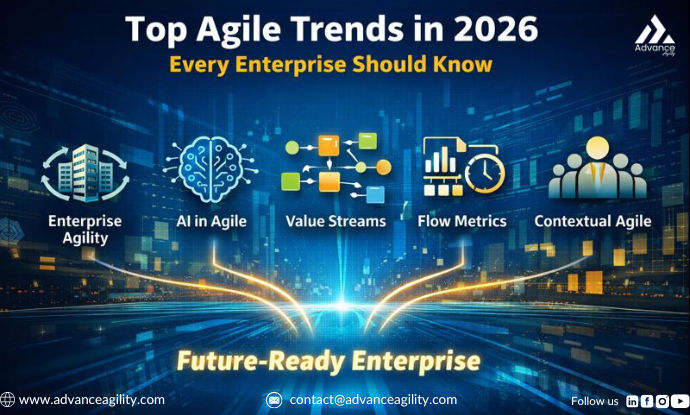
Below are the most important Agile trends in 2026 that leadership teams must understand to stay competitive.
1. Agile Becomes an Enterprise Capability, not a Team Practice
One of the biggest agility trends is the shift from team-level Agile to enterprise-wide agility.
In 2026, success will be measured by:
· Speed of strategic decision-making
· Time-to-market for business outcomes
· Ability to pivot priorities without organizational friction
Leadership takeaway: Agile ownership moves from delivery teams to senior leadership and portfolio governance.
2. AI in Agile Moves from Experimentation to Execution
AI in Agile is no longer a future concept—it’s becoming operational.
Enterprises are already using AI to:
· Predict delivery risks and dependencies
· Analyze flow efficiency and system bottlenecks
· Support backlog prioritization and planning decisions
By 2026, AI will act as an Agile co-pilot, enabling faster, data-informed decisions.
3. The Future of Agile Is Contextual, Not Prescriptive
Rigid, one-size-fits-all Agile frameworks are losing relevance.
Modern enterprises are:
· Adapting Agile to regulatory and legacy constraints
· Combining Agile, DevOps, and traditional governance models
· Designing fit-for-purpose agility
4. Value Streams Replace Projects as the Primary Operating Model
A major Agile trend in 2026 is the shift from project-based funding to value stream–based operating models.
Why?
· Projects optimize outputs
· Value streams optimize outcomes
By organizing around value streams, enterprises improve:
· Customer alignment
· Flow efficiency
· Long-term business impact
5. Flow Metrics Overtake Activity Metrics
Leadership dashboards are changing.
In place of velocity and utilization, organizations are tracking:
· Flow time
· Predictability
· Work in Progress (WIP)
· Business value realization
Agility trends insight: Metrics are becoming decision enablers—not reporting artifacts.
6. Agile Leadership Becomes a Critical Enterprise Skill
The future of Agile depends on leadership behavior.
By 2026, Agile success will require leaders who:
· Enable fast, decentralized decisions
· Create psychological safety
· Balance governance with empowerment
Agile will fail without Agile leaders, regardless of tools or frameworks.
What Enterprise Leaders Should Do Now
To prepare for Agile trends 2026, leaders should ask:
· Are we optimized for flow or control?
· Do our leaders understand agility beyond frameworks?
· Are we using AI to enhance decisions—or just automate tasks?
The answers to these questions will define enterprise competitiveness.
Enterprise leaders who want to prepare for Agile trends 2026 are investing in leadership enablement, value-stream thinking, and AI-aware Agile practices. If this resonates, now is the right time to reassess how agility truly operates in your organization.
Frequently Asked Questions

view Count
6445